The operating record for your returns bench
Your gut takes eleven minutes. Riuso takes seconds — and it remembers.
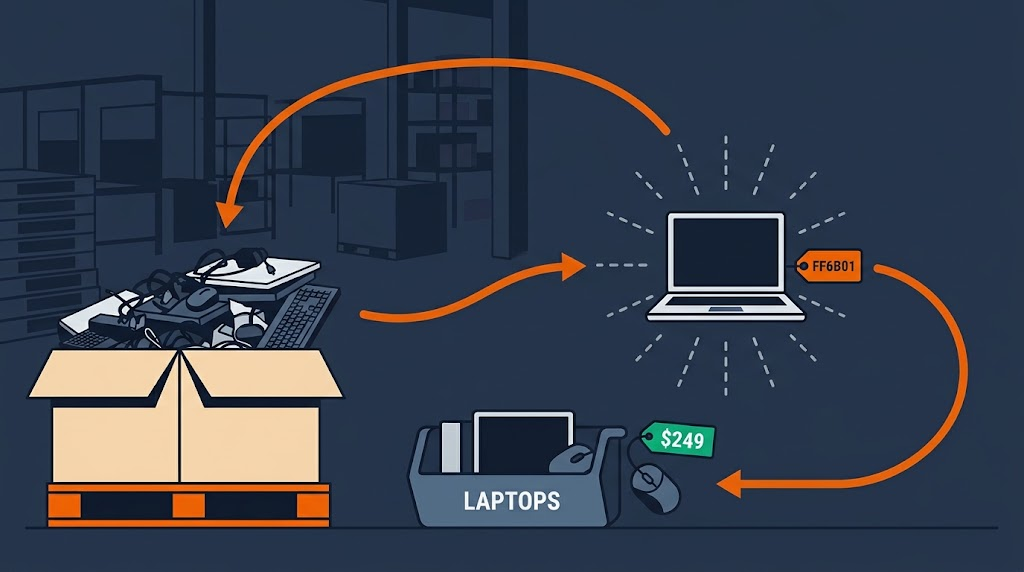
Riuso runs the returns and liquidation bench for owner-operated electronics resellers. It identifies every unit, grades it, prices every disposition route — including the ones you'd never bother to check — names the bin, and records what leaves the building. The second load is faster than the first, and the tenth is faster than the second, because nothing gets researched twice.
11 min → seconds
per-unit grade, identify and price decision
26% → 5%
of gross margin eaten by grading labour
Every route priced
resell, refurb, part-out, claim — pallet last
The problem
On a $20-margin unit, hand-grading is a quarter of your margin — gone before it's listed.
$5.13
The cost of deciding by hand
Eleven minutes of identify-grade-price at loaded warehouse labour is $5.13 per unit. On the ~$20 of gross margin this business runs on, that's 26% — the number that decides whether a pallet was worth buying at all.
“Broken. Pallet.”
Busy operators liquidate
Returns get worked after the outbound rush, not as they arrive. When the bench backs up, the default decision is the liquidation pallet — the worst-priced route — because it's the only one that takes zero research.
$185
Left on the table, per miss
A Dyson with a motor fault is $5 on the pallet. Its battery alone resells for $65; parted out, the unit is $190–230. A person grading by hand says “broken, liquidate” — and it takes fifteen minutes to leave that money there.
How it works
Two doors. One engine. Every item gets an address.
A bought pallet and a returned sale feed the same six-step engine. At receipt every unit gets a printed license plate and a cage location — from that moment it isn't “a Dyson somewhere in the warehouse,” it's RIU-8842-041 in cage R-12. Nothing materialises in a queue, and nothing gets lost between Thursday and the bench.
01 · Receive
Tag every unit with a license plate, assign a cage location, park it. Manifest shortfalls are caught at the door — and the claim starts drafting itself.
02 · Triage
Three photos. Riuso identifies the unit and grades it — and refuses to guess when it can't. Below its confidence floor, it escalates to you instead of pricing blind.
03 · Value
Every viable route priced from live comps: resell as-is, refurb, part-out by component, wholesale, pallet. Rejected routes shown with their numbers, not hidden.
04 · Decide
The highest-recovery route recommended, with a named bin. A number without a destination leaves someone holding an object with nowhere to put it.
05 · Execute
Pre-filled listing or claim packet. One tap to publish. The outbound identity — serial, IMEI, grade — is recorded as it leaves.
06 · Close
Found-vs-manifest reconciliation, load P&L, bench hours. The owner's screen: did the pallet make money?
One real decision: Dyson V8, motor fault RIU-8842-041
Liquidation pallet
$5
the default when you're busy
Resell as-is
$25–40
priced and rejected — shown anyway
Back Market refurb
$134
grade-B comp, priced and rejected
Part out · recommended
$190–230
battery $65 · wand $38 · cyclone $44
Decision time: 3.5 seconds — 0.4% of the manual budget, about three cents of labour.
The moat
It doesn't get smarter in general. It gets smarter about your bench.
Riuso fingerprints every unit it touches. Repeat SKUs skip research it has already done — a second Chromebook grades in 8 seconds instead of 33. Seller history accumulates: which liquidator's manifests run short, what your average recovery on a model actually is. That record only goes up, and it only belongs to you.
| Day 1 | Month 6 | |
|---|---|---|
| Analysis | Full research on every item | Instant on repeat models — this SKU priced 340 times |
| Seller intelligence | None | “This seller's manifests run 12% short — you've claimed $3,100 back” |
| Sell-side returns | No baseline | “You sold this IMEI in April at grade B. It came back grade C.” |
| Confidence | Model priors only | Raised by your own outcome history on known SKUs |
The product you're buying is the Month-6 column. The only way to get there is to start.
Both directions
Money leaks on the way out, too. Riuso records what leaves.
A Galaxy S22 comes back against an April sale — but the IMEI doesn't match the unit you shipped. Because Riuso recorded the outbound identity, that's not a shrug and a refund. It's a $389 claim with the evidence packet already assembled and a countdown to the filing window.
Same at the receiving door: 187 units found against a 220-unit manifest means a shortage claim drafts itself before anyone has opened a box.
Claims pipeline
IMEI mismatch — Galaxy S22
$389
evidence packet ready · window closes in 9 days
Manifest short — 33 of 220 units
$412
drafted at receiving, filed with load close-out
Why now
Reuse is stopping being a virtue and becoming law. The infrastructure has to exist.
Regulators on both sides of the Atlantic are pushing electronics away from the shredder and back into circulation — and every one of these regimes rewards the operator who can prove what a unit is, what grade it left in, and where it went. That proof is exactly what Riuso's operating record is.
EU Right to Repair
The 2024 Repair of Goods Directive obliges manufacturers to repair common devices and takes full effect across member states from 2026. More repair means more repaired and refurbished stock moving through secondary channels — and more demand for graded, provenance-backed units.
Digital Product Passports
Under the EU's Ecodesign for Sustainable Products Regulation, product passports carrying identity, repairability and lifecycle data are rolling out category by category. A unit-level record of identity, grade and history stops being nice-to-have and becomes the price of admission to EU resale.
US right-to-repair laws
California, New York, Minnesota, Colorado and Oregon now require manufacturers to supply parts, tools and documentation. Every new parts channel makes the part-out route — the one hand-graders never price — more liquid and more valuable.
EPR & destruction bans
Extended producer responsibility fees and the EU's ban on destroying unsold goods push retailers and brands to move returns into reuse channels instead of landfill. That flow lands on exactly the benches Riuso runs — with paperwork attached.
Behind all of it: the world generated a record ~62 million tonnes of e-waste in 2022, and less than a quarter was formally collected and recycled. The gap between “thrown away” and “worth money” is the market.
The numbers
Six months on a 500-unit/month bench, modelled.
$47,200
recovered above the liquidate-by-default baseline
$47,320
of grading labour that never happened — 1,690 bench hours
5.5 → 28.8
units per bench hour
$94 → $614
recovered value per bench hour on a closed load
Straight talk: these are modelled figures — plausible arithmetic from per-unit economics, not measurements from a customer bench yet. The two big numbers being nearly equal is the point: the recovery uplift gets your attention, but the labour collapse is what makes the next pallet worth buying. Validating both on your bench, with your loads, is precisely what the pilot is for.
Mission
Nothing worth money should die in a pallet.
Riuso — from the Italian for reuse — exists to make the second life of electronics as fast, priced and accountable as the first. We build for the owner-operators who actually run the reuse economy: the resellers and refurbishers working liquidation pallets and RMA returns on a bench, without an ERP, without a WMS, on $20 of margin a unit. Not a dashboard for someone else's warehouse — the operating record for yours.
Every unit that gets identified, graded, priced and re-sold instead of shredded is margin for the operator and a unit that never becomes e-waste. The incentives already point the same way. What's been missing is the speed — and the memory.
Pilot
Put Riuso on your bench for one load.
No integration project — there's nothing to integrate with, and that's deliberate. Riuso is the system of record for the bench. You receive a real pallet through it, work the items, close the load, and we compare the P&L and the bench hours against your current process. If the numbers don't hold on your loads, you'll know in two weeks and it cost you one pallet's worth of attention.
- ✓Runs on a phone and a label printer — no WMS, no ERP, no IT
- ✓Your data stays yours: the unit history we build belongs to your bench
- ✓Success is measured on load P&L and bench hours, agreed up front
See it on your loads, not ours.
A 20-minute demo, then a one-load pilot if the math looks like your bench.